Fighting in the Gaza Strip has escalated with what residents described as some of the most intense Israeli bombardment of the war, even as the enemies held what Washington called “very serious discussions” on a new truce.
According to analysis from the Institute for the Study of War and the AEI Critical Threats Project, Israeli forces had begun transitioning from clearing operations to holding operations in some areas of the northern Gaza Strip.
Bombing was at its most intense over the northern part of the Gaza Strip where orange flashes of explosions and black smoke could be seen as morning broke from across the fence in Israel. Planes roared overhead and the booms of air strikes thundered every few seconds, punctuated by rattling gunfire.
A map of the Gaza Strip shows Israeli forces ground incursions at three places along the southern-eastern border near Khan Younis. It also shows regions that have been demarcated as evacuation zones by the IDF.
The U.N. agency for Palestinian refugees UNRWA said more than 60% of Gaza’s infrastructure was destroyed or damaged, with more than 90% of the 2.3 million population uprooted.
In the ground war, Israeli tanks advanced further into the southern city of Khan Younis and shelled a market area but met heavy resistance, residents said.
Thousands of Hamas fighters, based in tunnels, are waging guerrilla-style war against Israeli forces.
Two side-by-side maps of Gaza show likely damage to buildings between Oct. 5 - Dec. 4 and Dec. 4 - Dec. 16. The first one shows a lot of damage in North Gaza and Gaza City. The latter shows more new damage in the south compared to the north.
At least 62% of buildings are likely damaged in North Gaza, 64% in Gaza City, 19% in Deir al-Balah, 25% in Khan Younis and 11% in Rafah governorate.
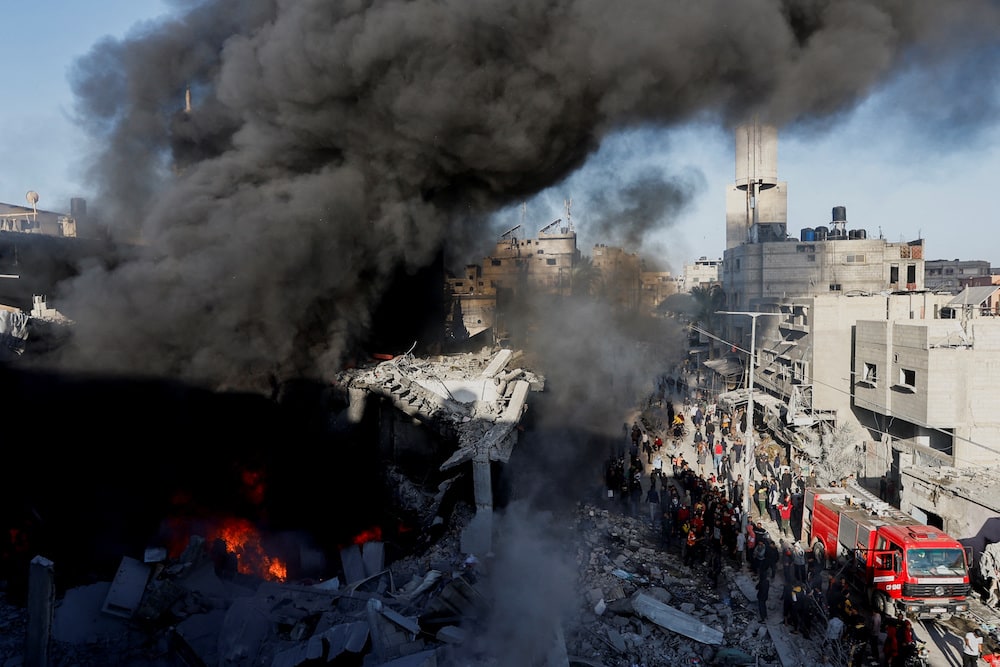
Since Israel’s bombardment in retaliation for Hamas’ Oct. 7 attack, nearly 20,000 Palestinians have been killed, according to health officials in Hamas-ruled Gaza.
U.N. officials have warned of a humanitarian catastrophe. The World Food Programme says half of Gaza's population is starving and only 10% of the food required has entered Gaza since Oct. 7.
Palestinians killed in Gaza war
An area chart shows the number of cumulative deaths from Oct. 7 to Dec. 19. The chart reaches a maximum of 19,667. A grey band marks the period of ceasefire between Nov. 24-29. Light orange bands mark periods with no death toll update. A marker on Oct. 28 reads “After over three weeks of heavy air strikes, Israeli ground forces enter Gaza”.
Read more: Mapping the conflict in Israel and Gaza.