Severe water shortages in Gaza following Israel’s total blockade of the enclave have “become a matter of life and death,” according to the United Nations.
Following the deadly Hamas rampage across southern Israel on Oct. 7, which killed more than 1,300 people, Israel ordered an immediate cut-off of the country’s water supplies to the Gaza Strip.
Desperate to get some drinking water, some people in Gaza have begun digging wells in areas adjacent to the sea or were relying on salty tap water from Gaza's only aquifer, which is contaminated with sewage and seawater.
The U.N. relief agency for Palestinian refugees said on Monday a quarter of a million people had been moved to shelters in 24 hours, the majority of which are U.N. schools where “clean water has actually run out.”
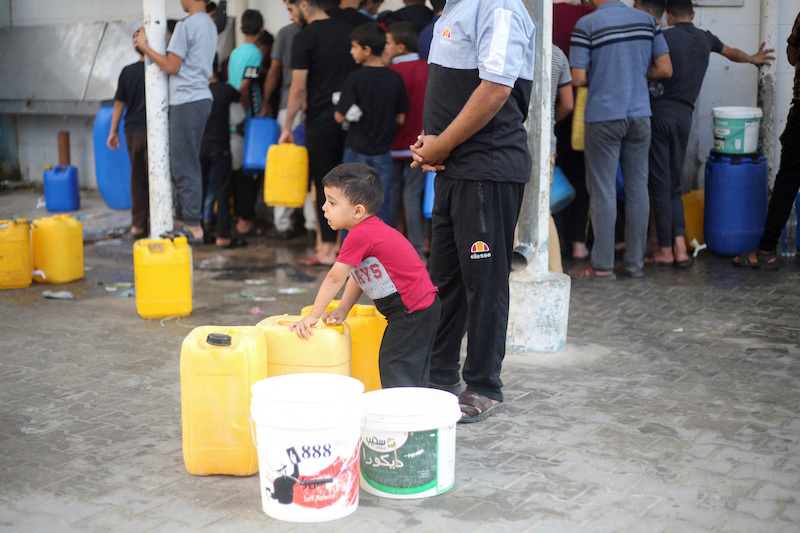
On Sunday, Israel’s energy minister said that a decision to renew water supplies to parts of southern Gaza was agreed on between Prime Minister Benjamin Netanyahu and U.S. President Joe Biden.
On Monday, Hamas said that Israel had yet to resume water supplies for the Gaza Strip despite pledging to do so, while an Israeli official responded that some water was being provided to an area in the south of the enclave.
Prior to the latest violence, Gaza’s water supply was already unable to meet the World Health Organization’s minimum requirement for daily per capita water consumption.
Bar chart comparing the daily water consumption in litres per capita in Gaza and Israel. Gaza consumes 83.1 litres compared with Israel’s 240-300 litres. The average water consumption recommended by the WHO is 100 litres per capita.
The Gaza Strip’s only natural source of water is the Coastal Aquifer Basin, which runs along the eastern Mediterranean coast from the northern Sinai Peninsula in Egypt, through Gaza and into Israel.
A 2020 study in the journal “Water” found the quality of the groundwater in the aquifer had “deteriorated rapidly,” in large part because it had been pumped out to meet the demands of Gaza’s large population quicker than it could be replaced by rainwater.
Map showing the Coastal Aquifer Basin along the west coast of Israel, the Gaza Strip and northern Egypt. The aquifer groundwater supply flows west.
The aquifer is also polluted by untreated wastewater, leaving 96.2% of household water from the aquifer undrinkable, according to a 2020 report from B’Tselem, the Israeli Information Center for Human Rights in the Occupied Territories.
As a result, 97% of Gazans rely on unregulated private water tankers and small-scale, often solar-powered desalination plants for drinking water, according to figures from the World Bank.
Map showing 3 desalination plants and 6 wastewater plants in the Gaza Strip. The desalination plants are along the coast of the Mediterranean Sea, and four of the wastewater plants are in northern Gaza with the other two in the south.
Three major desalination plants in Gaza have all ceased operation due to power restrictions imposed by Israel’s blockade.
That still leaves some smaller desalination operations, but the quality of water treatment in those plants can be spotty. According to a 2021 study, 79% of desalination plants in Gaza are unlicensed and an average of 12% of desalinated water samples tested still showed dangerous levels of contamination.
The U.N. said Gaza desperately needed fuel to restart pumping and treatment plants.
“We need to truck fuel into Gaza now. Fuel is the only way for people to have safe drinking water. If not, people will start dying of severe dehydration … Water is now the last remaining lifeline,” the U.N. said.
Read more: Mapping the conflict in Israel and Gaza.