Figure skating
has always featured spins and jumps
has always featured spins and jumps
But a quieter, less dramatic aspect of the sport has disappeared from the Olympic stage.
Athletes would train for hours each day, aiming to create perfect geometric shapes in clean ice.
This would be done on just one sharp edge of one skate.
Once complete, the skaters would repeat the figure several times on each skate to prove mastery.
Marks etched into the ice itself highlight their precision or deviation .
After which judges inspect the lines, turns, and loops to determine the score.
The figures, which once contributed as much as half of an Olympic competitor’s score, have long since disappeared from the sport.
Figure skating has become a sport that awards athletes for achieving speed, spins and jumps – and the ability to land with grace on a steel blade 4 mm (0.16-inch) wide on a notoriously slippery surface.
“It’s a very exciting sport,” said 1984 US Olympic figure skating gold medalist Scott Hamilton. “It’s sort of the athlete against the elements, which is basically trying to master a surface of ice in a really profound and athletic way.”
But there is much less adrenaline at the roots of the sport, grounded in quiet precision and artistry. It was defined less by what the skater did above the ice than the patterns left in the ice itself.
These meticulously etched marks are the figures of figure skating.
The term ‘figure’ in the sport’s name is not unique to English, as several languages, from Irish to Polish and Russian, also translate the name literally as ‘figure skating.’ In contrast, Japanese and Korean adopt ‘figure’ as a phonetic loan word, preserving the English sound.
The International Skating Union (ISU), which organises the World Championships, officially uses the term ‘figure skating,’ though many other languages often describe the sport as ‘art skating,’ emphasising its aesthetic qualities.
Figures test the ability to hold and change an edge, change direction or even a skate, quickly and confidently, as well as maintaining a high level of precision and grace throughout. The skater always starts at the point where two circles meet and each figure is skated multiple times on each foot.
A grid of eight fundamental figure skating patterns: Circle Eight, Serpentine, Three, Bracket, Double Three, Rocker, Change Loop, and Paragraph Loop. Each shows the path a skater would trace on the ice, with different colors indicating changes of direction and skates.
The sport of figure skating has 41 compulsory figure variations that increase in difficulty, but they all arise from the perfect geometry of a circle. The most fundamental compulsory figure is two circles connected at their edge, or a figure eight. This shape distills several skills highly prized in the sport: skating on an edge, skating a curved line and being able to change directions and edges - all ideally while maintaining a graceful form, with the entire body above the ankle.
The difficulty increases with how the figure is to be executed, with multiple variations for each shape. A figure eight grows in difficulty, for example, depending on whether the skater is allowed to switch the skating foot during the figure or perform the entire pattern on one skate with one push. Some shapes require the skater to turn to the inside or outside of the circle, or to extend the shape into a serpentine, which is three circles of equal size with various turns or loops included.
The figures were to be skated not just once, but multiple times on each foot, alternating each pass, to ensure the skater had definitive mastery of the shape with both feet. The more difficult patterns require extreme precision to perform the same twists and turns at the exact same time during each tracing, or the ice itself would record the digression.
“It was a developmental system that was exquisite,” said US Olympic figure skater and 1972 bronze medalist Janet Lynn, during a talk at the Midway Village Musem in Rockford, Illinois. “It was genius.”
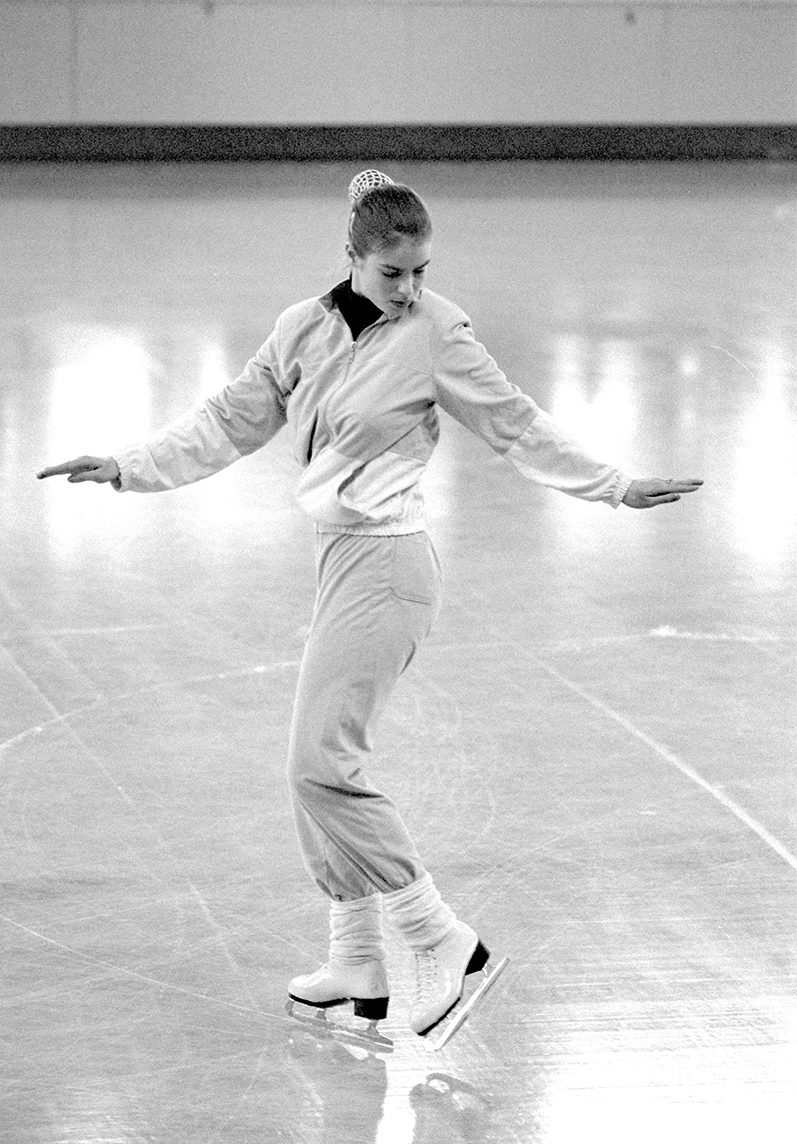
Olympic figure skating champ Katarina Witt of East Germany performs a compulsory figure at the World Figure Skating Championships in Tokyo in 1985. Shunsuke Akatsuka/REUTERS
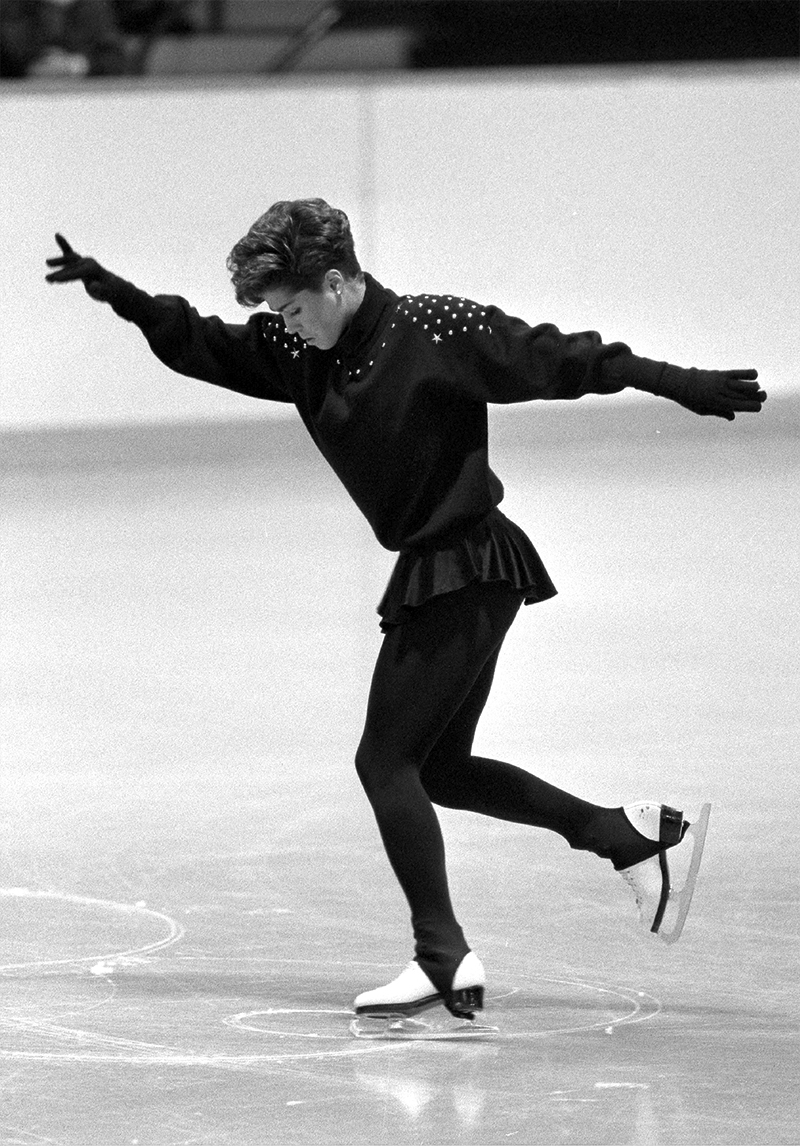
US skater Jill Trenary goes through her compulsory figures at the Skate Canada competition in 1988. Mike Blake/REUTERS
“We had to glide on one foot, on a thin blade, and because of the circular movement you were on a slight lean, and on an edge … so there was a clean line, one line, and you had to change the edge at the very tip of the turn and you could actually read the tracing on the ice as to whether you did it properly or not,” said Lynn.
In competitions, judges would descend on the ice to closely inspect the tracings left by the skater, to see how closely the lines overlapped or deviated, especially at turns, to check if they were crisp, decisive and matched the other attempts. The original scoring system in the skating world was born from the number of times each skater had to perform each figure - with a perfect 6 being the best score possible.
The utility of the figures lies in the strength and durability the effort builds in the skater’s body and mind. “This was the foundation of my skating, the foundation of everything I did,” said Lynn. “Consider how strong the body would become if you were gliding on one foot or the other for four to six hours a day in the exact position you need to be in to take off from a jump and to land a jump in a way that is non-impactful, how strong would that make your body? It would make it very strong, and I was.”
Hamilton described the benefits of figures as they transfer to the free skating portion. “There’s a consistency element because you’ve mastered the edge, the edge isn’t the master of you,” he said. And the consistency of edge control is paramount when learning to jump.
A visual showing the boot of an ice skate and how the blades are positioned across the entire piece of equipment.
“When kids are learning to judge their jump preparations, you better be in perfect position, set in perfect control and knowing exactly where every aspect of your body is … you’re moving into a position that will either guarantee your success or doom you to failure,” he said.
For most of the time figure skating has been in the Olympics, compulsory figures had been weighted to be worth more than the free skating segment. As the competition began to be televised in the 1960s, this scoring structure became a curiosity to viewers at home, as the tedious and precise tracing of circular patterns in the ice was not especially spectator friendly - unlike the free skate, which allowed for much more artistic expression through costumes, jumps and spins set to music. The compulsory figures’ weight in the total score for figure skating has shrunk over time, most visibly in the 1960s and 1970s, when the value dropped from 60% to less than a third of the total.
This contrast was on display in the 1972 Sapporo Olympics, when Austria’s Beatrix “Trixi” Schuba took a commanding lead in the figure competition held two days before the free skating - so commanding that despite a seventh-place finish in the free skate, she still took home the gold medal. This is the lowest placement in this section by a gold medalist, and the audience attending the free skate and medal ceremony reportedly booed the result.
The United States’ Janet Lynn, who placed fourth in the figures, was an exceptional free skater and placed first in the free skate, but was still only able to secure a bronze overall. But the resulting disconnect between her free skate performance and the third place medal may have been a harbinger of things to come. By the time of the next Winter Olympics, compulsory figures dropped from half the score to just 30%, signifying their weakening place in the sport and the rise of free skating.
In 1990, the ISU voted to remove compulsory figures from competition, allowing skaters to focus more on the free skating aspects. This coincides with skaters’ continual addition of rotations to their jumps. Double rotation jumps were conquered by the late 1940s, with Dick Button completing the axel, the most difficult jump, due to the liftoff that does not use the toepick and on a forward edge. All jumps land with the skater facing backwards, so the axel, with a forward liftoff and backwards landing, necessitates an extra half rotation. The triples of all the jumps were completed in the 1950s and 1960s, with the axel once again lagging until 1978.
“The natural tendency for sport is the next guy is going to be better than the last guy, right?” said Hamilton. ”You’re going to elevate … It’s just a natural progression of sport.”
A chart showing the evolution of the routine in figure skating since 1988
This trend has culminated with a quadruple axel performed by USA’s Illia Manlin, a feat that requires 4-1/2 revolutions before landing due to the nature of the front-facing takeoff and backwards landing. Manlin, nicknamed the “Quad God” for his ability, is also the first skater to land seven quadruple jumps in a single program.
Since the removal of compulsory figures, the increase in athleticism can be seen in the difficulty ratings over time. Every jump and spin has a difficulty rating and the ratings shift every few years to incorporate the new and more difficult elements. A comparison of free skating routines between the 2004 and 2022 gold medalists, with the application of the most recent difficulty ratings, shows how much more challenging the individual elements and routines as a whole have become.
How two gold medal routines compare under current difficulty ratings
A bar chart of the total and individual difficulty ratings for each element in the gold medal routines from 2004 and 2022.
Beyond the full array of quadruple jumps appearing this year, there is another notable element — but it has only one rotation. The backflip is back in play after having been banned by the ISU in Olympic competition since 1977. The move has only once been performed legally, in the 1976 Olympics, and was banned as being too dangerous. And since, in 1976, it was landed on both skates at the same time, it also violated the edict that all jumps be landed on one skate.
Then, in defiance of the rule, in 1998, French figure skater Surya Bonaly performed the backflip. By managing to land on one skate she proved it was possible, earning a spot a in skating history but a deduction from the judges. The ISU has relented and while no deductions will be made for a backflip, it is also not considered a judged element, so it will not add to the skater’s score in any way.
At least not in this Olympics.
Additional Development by
Han Huang and Anand Katakam
Share Cover Image by
Arathy Aluckal
Sources
Skateguardblog; International Skating Union; U.S. Figure Skating; Video: Reuters
Edited by
Simon Scarr and Clarence Fernandez